

"Chicken vs Zombies" isn't a traditional slot or table game—it's a skill-influenced arcade battler where survival time directly controls your payout multiplier. The longer you last, the higher your potential win. But this format carries high risk: one mistake ends the round instantly. This guide breaks down the actual mechanics, strategic choices, and realistic expectations—no hype, just math and method.
At its core, "Chicken vs Zombies" is a real-time survival game. You control a chicken (or similar character) dodging waves of zombies. Each second survived increases your win multiplier. The game ends the moment you're hit—there's no second chance. Your final payout is calculated as:
Final Win = Base Bet × Final Multiplier
Unlike slots with RNG-driven outcomes, your actions directly influence the multiplier—making it a hybrid of skill and chance. However, this doesn't eliminate the house edge. Over time, the game's design ensures negative expected value (EV) for the player, consistent with casino norms.
| Difficulty Mode | Total Zombies | Risk Level | Multiplier Progression |
|---|---|---|---|
| EASY | 30 Zombies | Lower Risk | Slower climb, more frequent small wins |
| MEDIUM | 25 Zombies | Moderate Risk | Balanced progression |
| HARD | 22 Zombies | High Risk | Faster multiplier growth, higher difficulty |
| HARDCORE | 18 Zombies | Maximum Risk | Exponential gains require exceptional skill |
Key behavioral traits:
| Element | Function | Player Impact |
|---|---|---|
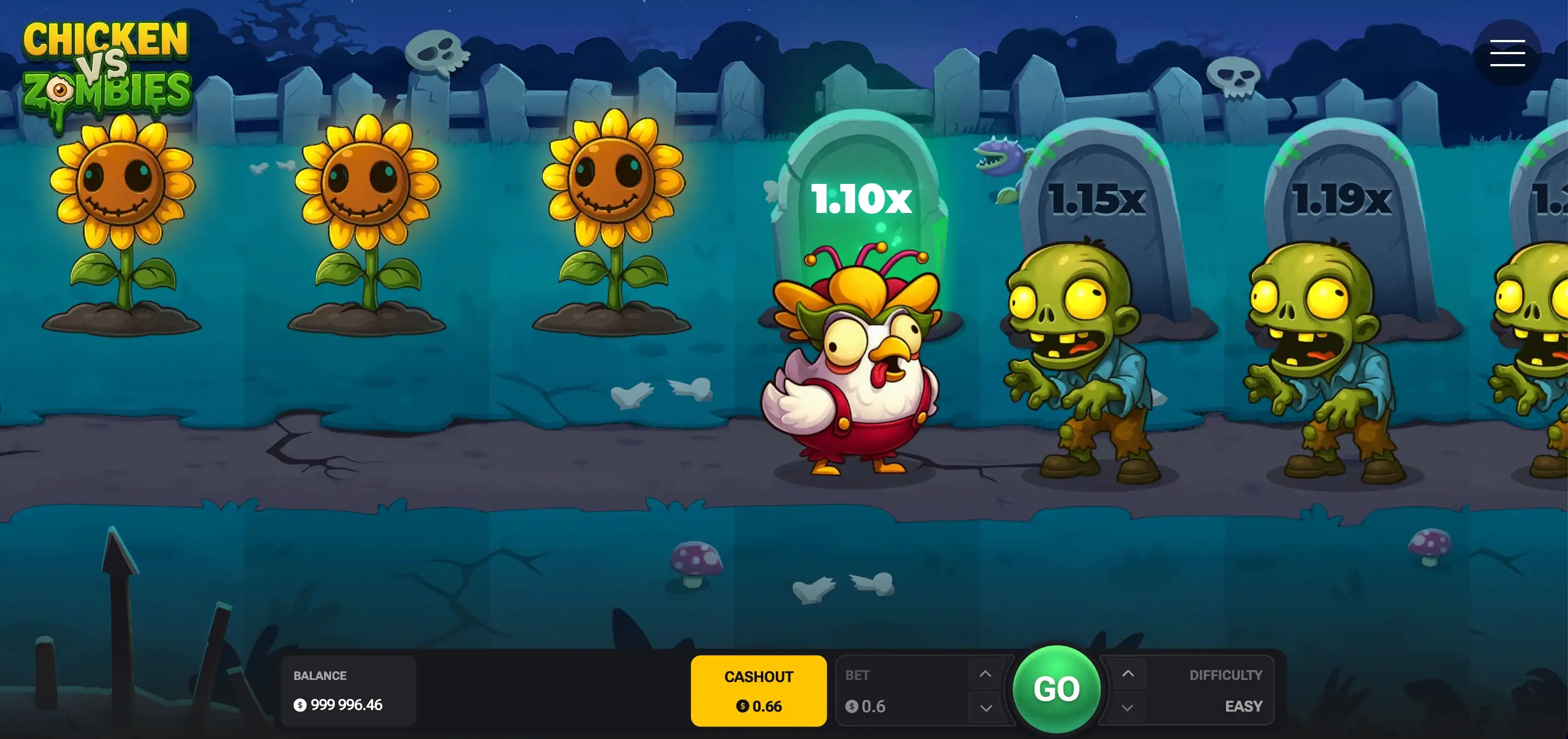
| Brave Chicken Hero | Player-controlled character on left side | Movement and timing directly affect survival duration |
| Zombie Waves | Sequential enemies guarding tombstones | Each defeated zombie unlocks next multiplier tier |
| Sunflower Victory Markers | Visual progress indicators | Track how many zombies conquered in current run |
| Instant Cashout Button | Orange button showing current winnings | Click anytime to collect before being hit—timing critical |
| Graveyard Environment | Navy blue gradient with teal-cyan fog | Atmospheric setting; tombstones glow green when conquered |
Don't be fooled by streamers showing 100x+ wins. Those are statistical outliers. In reality, "Chicken vs Zombies" operates with a built-in house edge—the game features a 95.5% RTP according to official data, meaning a 4.5% house edge long-term.
Using expected value (EV) principles:
| Metric | Value | Meaning for Players |
|---|---|---|
| RTP Rate | 95.5% | Long-term average return—not per-session guarantee |
| House Edge | 4.5% | Expected loss rate over large sample sizes |
| Max Win Potential | 870,000 RUB | Theoretical maximum payout (extremely rare) |
| Release Year | 2025 | Modern game design with current fairness standards |
| Provider | InOut | Uses provably fair technology (SHA256 hashing) |
Since survival time = multiplier, improving your play directly increases your average return. But remember: no strategy beats the house edge long-term. These tips only help you get closer to the theoretical RTP.
Play in demo mode (if available) to learn movement patterns and zombie behavior. Build muscle memory to reduce reaction time before risking real stakes.
Most zombie spawns come from edges. Keeping your character near the center maximizes escape routes and reaction windows.
Many versions use predictable spawn sequences after the first 10–15 seconds. Study and anticipate these patterns to improve survival rates.
Start with EASY mode (30 zombies) while learning. Only move to MEDIUM/HARD/HARDCORE after consistent performance—higher risk doesn't guarantee higher returns without skill.
Never chase losses or "test a strategy" with large stakes. Keep bets at minimum levels until you've mastered the mechanics.
The orange cashout button shows your current winnings in real-time. Set personal multiplier targets (e.g., 5x, 10x) and cash out when reached—greed often leads to losing everything.
Pre-decide a session loss limit (e.g., "I'll stop after $10 total loss") and stop immediately when reached. This prevents emotional decisions.
Warning: Some players believe "the game owes them a win" after a dry streak. Past losses don't increase future win probability. The provably fair RNG ensures every outcome is random.
"Chicken vs Zombies" is high-volatility by design: frequent small losses, rare large wins. Your bankroll must reflect that.
| Session Budget | Recommended Bet Size | Number of Rounds | Risk Profile |
|---|---|---|---|
| $10 | $0.20–$0.50 | 20–50 rounds | Conservative—learning phase |
| $20 | $0.40–$1.00 | 20–50 rounds | Moderate—balanced approach |
| $50 | $1.00–$2.00 | 25–50 rounds | Experienced—higher stakes acceptable |
| $100+ | $2.00–$5.00 | 20–50 rounds | High-roller—requires discipline |
Remember: high volatility means even a "successful" session can end in a net loss. Focus on maximizing entertainment value per dollar, not profit.
Most losses in "Chicken vs Zombies" come from behavioral errors, not bad luck:
Fix: Treat it like a video game with real-money stakes. Set time and loss limits before you start, track your performance, and take breaks when frustration builds.
"Chicken vs Zombies" is fast-paced and engaging—which can encourage prolonged play. Always:
18+ only. Gambling involves risk of financial loss.
No—the game uses provably fair technology with SHA256 server seed hashing combined with client seeds. If played at a licensed casino, outcomes are verifiable and fair. However, the payout structure ensures the house has a long-term 4.5% edge. Skill affects your multiplier, but not the underlying expected value.
Yes, but it's rare. The maximum win potential is 870,000 RUB (or equivalent). High multipliers require exceptional survival time, which happens infrequently. Treat big wins as statistical outliers, not expected outcomes.
Yes—better reflexes and pattern recognition help you survive longer, which increases your average return per round. However, it won't turn the game into a profitable endeavor long-term due to the 4.5% house edge. Practice helps you reach the theoretical 95.5% RTP more consistently, but not exceed it.
Difficulty modes change the number of zombies you face: EASY (30), MEDIUM (25), HARD (22), HARDCORE (18). Fewer zombies mean each victory compounds the multiplier faster, but also increases difficulty. Beginners should start with EASY mode to build skills before attempting higher-risk modes.
The bright orange cashout button appears during gameplay and shows your current winnings in real-time. Click it anytime to collect your stake multiplied by the current multiplier before being hit. Timing is critical—waiting too long results in losing everything if a zombie hits you.
Yes—the official RTP is 95.5%, meaning a 4.5% house edge. This is calculated over millions of rounds. Your individual session results will vary significantly due to high volatility. Short-term outcomes can range from total loss to substantial wins, but long-term play trends toward the 95.5% return rate.
The game uses SHA256 server seed hashing combined with client seeds, allowing players to verify that results weren't manipulated. Each round's outcome is determined by cryptographic algorithms that can be independently verified. This transparency ensures fairness while maintaining the built-in house edge.
No—this is a classic gambling fallacy known as "chasing losses." Each round is independent with the same house edge. Increasing bets after losses accelerates bankroll depletion without improving your odds. Maintain consistent bet sizes aligned with your total session budget and stop when you hit pre-set loss limits.